

How to Choose a Chemical Supplier in the UK
Your one-stop-shop for all your chemical needs
Why the choice of supplier matters more than it first appears
For most trade and industrial buyers, a chemical is a chemical — until the wrong pack size arrives late, the paperwork is missing, or a product that worked fine last time is suddenly a different grade. Choosing a chemical supplier is rarely just about finding a business that stocks the product you need; it’s about finding one you can depend on order after order, across the full range of things your business actually buys.
This article sets out a practical checklist to work through when comparing UK chemical suppliers, whatever sector you’re buying for — industrial, agricultural, water treatment, cleaning, food or otherwise.
1. Range and grades
Start with the basics: does the supplier stock the specific chemical, grade and concentration you need, not just something similar? Many chemicals are available in multiple grades — technical, food grade, and different concentrations or purities — and using the wrong one can affect your process, your compliance position, or both.
It’s also worth checking whether a supplier’s range covers enough of what you buy regularly. A supplier with a genuinely wide range across commodity and speciality chemicals means fewer separate accounts and deliveries to manage, which matters more than it sounds once you’re juggling several suppliers for a handful of products each.
2. Pack formats and order flexibility
Chemical suppliers vary considerably in how flexible they are on quantity. Look for a supplier who can offer:
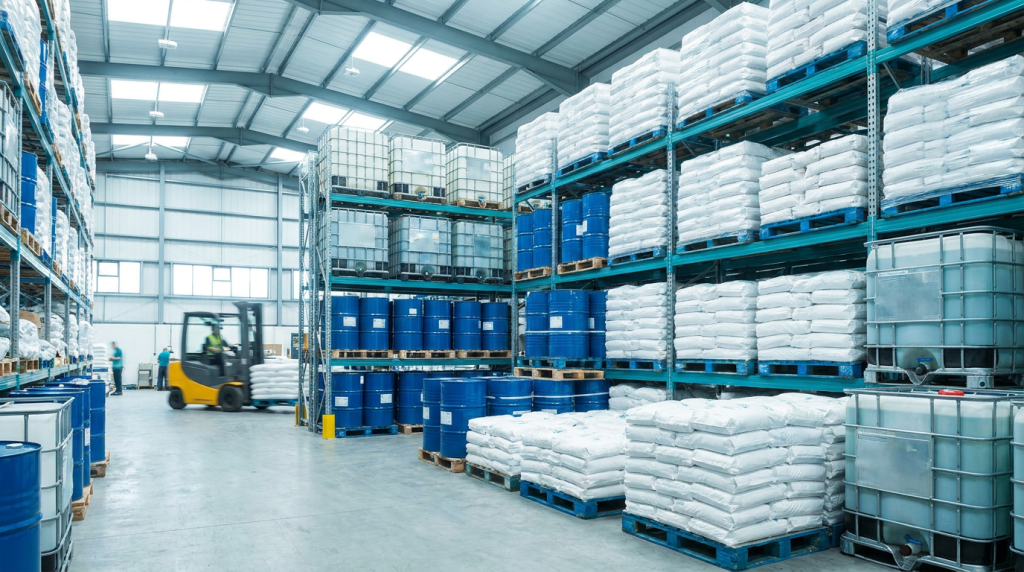
- Small pack formats (such as 25kg bags) for trials, low-volume use, or businesses without bulk storage
- Drums, for mid-volume liquid or solid chemical orders
- IBCs (intermediate bulk containers), for larger liquid volumes without needing tanker delivery
- Bulk/tanker delivery, for high-volume, ongoing industrial demand
A supplier that only offers one or two of these formats will eventually force you to either over-order, under-order, or go elsewhere for part of your requirement. Being able to scale up or down in pack size as your needs change, without switching supplier, is a genuine practical advantage.
3. Documentation and SDS provision
A supplier should be able to provide a current Safety Data Sheet (SDS) for every hazardous product, promptly and without it being difficult to obtain. This isn’t a nice-to-have — it’s central to your own COSHH compliance and to briefing anyone who’ll handle the product. See our guides on what an SDS is and COSHH for chemical buyers for more on why this matters.
Ask a prospective supplier directly: can they provide an SDS before you order, not just after delivery? Is documentation up to date and specific to the exact product and pack size you’re buying, rather than a generic sheet for “similar” products?
4. Delivery capability and coverage
If your business operates from a single site or across several, check that a supplier can deliver reliably to where you actually need the product — not just to a limited regional area. Nationwide UK delivery, across all the pack formats you use, removes one more variable from your supply chain.
It’s also worth understanding realistic lead times upfront, particularly for bulk or tanker orders, which may need more notice than a drum or bag delivery. A supplier who’s upfront about lead times before you order is generally a better sign than one who only raises it once you’re waiting.
5. Consistency of supply
For any chemical you order repeatedly, consistency matters as much as the first order going well. Consider:
- Does the supplier hold enough stock to avoid regular out-of-stock delays on your core products?
- Is the product you receive consistent batch to batch, in line with its specification?
- Does the supplier communicate proactively if a product is temporarily unavailable, rather than leaving you to chase?
A track record of trading matters here. A UK chemical supplier operating since 1999, for example, has been through enough order cycles and market conditions to have a genuine pattern of supply behaviour you can ask about — worth more than a promise on a website.
6. Responsiveness
Finally, how easy is a supplier to actually deal with when something isn’t routine? Test this before you commit to an account, not after: send a specific enquiry — a grade question, a delivery query, an SDS request — and see how quickly and clearly you get an answer. A supplier who’s slow or vague at the enquiry stage is unlikely to improve once you’re a regular customer.
Putting the checklist together
No single factor above should be a dealbreaker on its own, but weighed together they give a realistic picture of what working with a supplier will actually be like: range and grades to make sure they can meet the spec, pack formats and delivery to make sure they can meet the volume and location, documentation to make sure you can stay compliant, and consistency and responsiveness to make sure the relationship holds up beyond the first order.
Always refer to the product’s own Safety Data Sheet, obtained from your chosen supplier, for hazard, handling and storage information specific to that chemical.
This article offers general, practical guidance for comparing chemical suppliers and does not constitute procurement, legal or regulatory advice. Your own due diligence, including checks relevant to your sector and compliance obligations, remains your responsibility.
H&I Chemicals is a UK-based chemical supplier trading since 1999, with a wide range of commodity and speciality chemicals supplied in 25kg bags, drums, IBCs and bulk, with nationwide UK delivery. If you’d like to test how we handle an enquiry, get in touch and request a quote.