

What Is a Safety Data Sheet (SDS)? A Buyer’s Guide
Your one-stop-shop for all your chemical needs
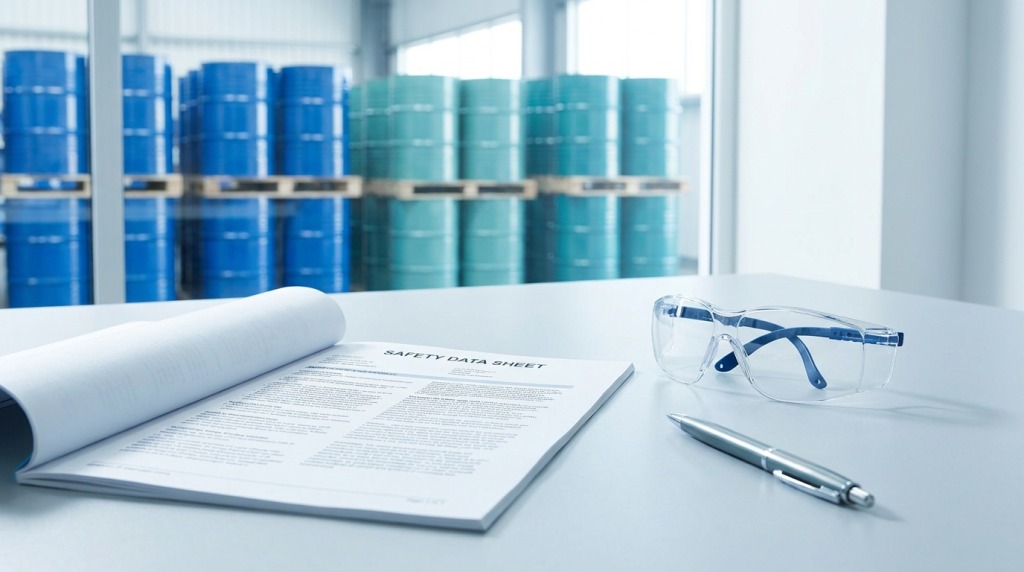
What is a Safety Data Sheet?
A Safety Data Sheet, usually shortened to SDS (and still sometimes called an MSDS, or Material Safety Data Sheet, under older terminology), is a standardised document that accompanies a hazardous chemical product. It sets out what the substance or mixture is, what hazards it presents, and how to handle, store, transport and dispose of it safely.
If you buy or use chemicals in a UK workplace — whether that’s a single drum of a cleaning chemical or a bulk tanker of an industrial acid — the SDS for that product is the single most important document you receive with it. It’s written for professional and industrial use, not consumers, so it goes into far more technical detail than a product label ever could.
Why SDSs exist: the UK REACH and CLP framework
In the UK, the requirement to supply an SDS with hazardous chemicals sits within the UK REACH (Registration, Evaluation, Authorisation and Restriction of Chemicals) framework, alongside the CLP (Classification, Labelling and Packaging) Regulation, which governs how hazards are classified and communicated. Together, these regulations set out when a supplier must provide an SDS, what information it must contain, and in what format.
The Health and Safety Executive (HSE) is the UK authority responsible for chemical safety regulation and enforcement, and its website is the best starting point if you want the primary regulatory detail behind any of this rather than a summary. If you’re ever unsure whether a specific product needs an SDS, or what a term in one means, HSE guidance is the authoritative source — not a supplier’s marketing copy, including ours.
The 16 sections of an SDS
Every SDS follows the same internationally recognised 16-section structure, so once you know the format, you can navigate any manufacturer’s SDS in broadly the same way. Briefly, those sections cover:
- 1. Identification — the product name, supplier details and recommended use
- 2. Hazard(s) identification — the classification of the substance and the hazard symbols and statements that apply
- 3. Composition/information on ingredients — what the substance or mixture actually contains
- 4. First-aid measures — what to do in the event of exposure by contact, inhalation or ingestion
- 5. Fire-fighting measures — suitable extinguishing media and specific hazards
- 6. Accidental release measures — how to respond to a spill
- 7. Handling and storage — safe handling practices and storage conditions
- 8. Exposure controls/personal protection — exposure limits and required PPE
- 9. Physical and chemical properties — appearance, pH, flash point, solubility and similar data
- 10. Stability and reactivity — conditions to avoid and incompatible materials
- 11. Toxicological information — health effects data
- 12. Ecological information — environmental hazard and fate data
- 13. Disposal considerations — how to dispose of the product and its packaging
- 14. Transport information — classification for road, rail, sea or air transport
- 15. Regulatory information — specific regulations that apply to the substance
- 16. Other information — anything not covered above, such as revision history
Not every section will be equally relevant to every role in your business. A warehouse team handling a delivery will care most about sections 2, 7 and 8; a transport planner will care about section 14; whoever holds first-aid responsibility needs section 4 close to hand.
Who has to provide an SDS
Under UK REACH and CLP, suppliers of hazardous substances and mixtures are generally required to provide an SDS to business (downstream) customers, free of charge, either with the first delivery of a product or before it. It should be supplied in an appropriate format and kept up to date as the substance’s classification or the underlying regulations change. The exact obligations depend on how a particular substance is classified and how it’s supplied, so if you have a specific compliance question about an individual product, HSE guidance — or a competent health and safety adviser — is the right place to check the detail, rather than a general article like this one.
How buyers should actually use an SDS
An SDS isn’t something to file away unread once a delivery arrives. As a buyer, it’s worth treating it as a working document rather than paperwork:
- Read sections 2, 7 and 8 before the first delivery arrives, so your team knows in advance what PPE and storage arrangements are needed.
- Use section 4 to brief anyone who might need to respond to a spill or exposure incident, and keep a copy accessible near where the product is stored or used.
- Check section 14 if you’re arranging your own onward transport of the product.
- Confirm you’re looking at the current version — SDSs are revised periodically, and an old copy on file may not reflect the latest classification or guidance.
- Feed the relevant sections into your own COSHH assessment for the substance — our companion article, COSHH Explained for Chemical Buyers, covers how that process works.
The SDS is also a useful sense-check when comparing similar products: differences in hazard classification, handling requirements or storage conditions between two comparable chemicals are often visible in the SDS well before they show up anywhere else.
Where to go for more
If a question isn’t answered clearly enough in a product’s SDS, or you want to understand the wider regulatory picture rather than a single document, the HSE website is the authoritative UK source on chemical safety, REACH and CLP obligations. Treat supplier articles like this one — including our own — as a starting point for orientation, not a substitute for the primary guidance or the SDS itself.
Always refer to the product’s Safety Data Sheet as the authoritative source for hazard, handling, storage and emergency information for that specific chemical.
This article is general, factual information about Safety Data Sheets and the UK REACH/CLP framework, provided for background only. It does not constitute health and safety, legal or regulatory advice, and it is not a substitute for a product’s own SDS or for a proper risk assessment carried out for your own site and activities. For guidance specific to your business, consult the HSE or a qualified health and safety adviser.
An SDS is available for every product in our chemicals range — if you need a copy ahead of ordering, want to check a specific product’s classification, or are ready to order, get in touch with H&I Chemicals and request a quote.